THE EIGHT IMMORTALS · No. 2 OF 8
Zhongli Quan
Patriarch Zhengyang · The Zhong–Lü Transmission
Courtesy name Jidao (some say Yunfang), Taoist name Zhengyangzi; also called Han Zhongli; honored as Patriarch Zhengyang and Master Yunfang
Zhongli Quan · At a Glance
- Attribute
- Palm-leaf fan (the plantain fan), peach
- Hidden Eight Immortals symbolism
- The fan — "Lightly waving the fan in carefree joy" — it can raise the dead
- Patron of
- Silversmiths
- Birthday
- 15th day of the 4th lunar month
- Folk counterpart
- The "noble" among male, female, old, young, rich, noble, poor, and lowly
Origins and Ascension
From general to immortal
The standard legend says that at his birth shafts of light filled the room and he cried for seven days, his first words meaning "my body roams the Purple Palace, my name is written in the Jade Capital." Following his father into service — Baidu Baike has the father as an Eastern Han general and Zhongli Quan rising to Grand Master of Remonstrance — he was sent against Tibet, given only old and weak troops by the jealous Liang Ji, and after defeat fled alone into the mountains.[2][3]
There he met Master Donghua, Wang Xuanfu (some say the Lord of the Eastern Florescence), who taught him the secrets of longevity, the firing times of the golden elixir, and the Azure Dragon swordplay; after further teachings from the Huayang Zhenren he attained the Way on Zijin Sihao Peak of the Kongtong Mountains. Coming down, he turned stones into gold and silver with alchemy and his magic fan to relieve the poor. Later Taoists keep the 15th day of the 4th lunar month as his birthday.[3][2]
Journey to the East supplies richer detail: at his birth "marvelous light shone several spans, like a blaze," and the infant, born like a three-year-old, "neither cried nor spoke nor ate, night or day," until the seventh day, when he suddenly spoke: "My body roams the Purple Palace, my name is written in the Jade Capital" — claiming descent from the Jade Capital's immortal company. In the Comprehensive Mirror tradition his mother dreamed "the ancient Yellow God-king shall be born here," and he was named Quan ("balance") for knowing the weight of things from childhood.[8]
Journey to the East also adds a dramatic twist: the one who defeated Zhongli was none other than Li Tieguai — fearing that victory and rank would sink Zhongli too deep into the world to find the Way, he took the form of an old man to urge the barbarian general Nian Buqian to raid the Han camp by night, and set fire to it himself; Zhongli's army was annihilated and he fled alone into the mountains. Lost, he was led by a monk to the retreat of Master Donghua, where the old man opened the door with "Has the Han great general Zhongli Quan come?" and entertained him with magu wine and hemp-seed rice, saying "rank and wealth are but floating clouds" and "for the nourishing of life there is nothing else — empty the heart, fill the belly," teaching him the secret of longevity, the firing times of the golden elixir, and the Azure Dragon swordplay. The next morning the estate was gone.[8]
Tales and Anecdotes
Turning stone to gold: testing Lü Dongbin
The best-known "testing" story is the stone-to-gold test. The Ming-era book of moral tales Liao Fan's Four Lessons records: Zhongli taught Lü Dongbin the art of "touching iron and turning it to gold, to relieve the world." Lü asked: "Will it ever revert?" "After five hundred years it returns to its substance." "Then it would harm people five hundred years from now — I will not do it." Zhongli sighed: "To cultivate immortality one must accumulate three thousand deeds of merit; in this one sentence you have completed all three thousand."[11]
The folk version is more theatrical: Zhongli made Lü Dongbin carry a boulder up a mountain for three years to temper his will; one day, with a cry of "Change!", the stone became gold. When Lü asked "Can you swear it will never change back?" and learned that the gold would revert to stone after five hundred years, he refused the art: "To profit five hundred years and harm five hundred years — how can I?" Zhongli sighed: "Your mind for the Way surpasses mine; your fruition will be above mine." — the disciple's heart proved deeper than the master's, and he admired rather than envied it.[12]
Turning gold to feed the people
Chapter 18 of Journey to the East, "Turning Gold to Aid the Multitude," shows him relieving famine: cultivating with his elder brother Zhongli Jian in a thatched hut on Mount Hua, he came down one day to find "the roads filled with the poor" — the harvests had failed and the old and weak lay in the ditches. His brother prodded him: "You know the way of the golden elixir and will not save the people of this age — of what use is your attainment?" He took copper and tin, "put in a little spirit medicine and burned them, and all became treasure," which he distributed among the poor — "those who lived by it numbered a million households." The gold-turning art here is not display but charity.[9]
Delivering Lan Caihe
The Yuan zaju Han Zhongli Delivers Lan Caihe best shows his patience and craftiness as a converter: seeing that Xu Jian (stage name Lan Caihe), an actor of the Liangyuan shed-theater in Luoyang, had "half an immortal's destiny," he descended to convert him in person — lounging on the music bench until Lan Caihe locked him in, laughing, "If this man never sees a bad turn, how would he ever leave the household?"[10]
On Lan Caihe's birthday the next day, he came to the door "weeping three times and laughing three times," prophesying "today you are a star of long life; tomorrow you may be a star of disaster" — then had Lü Dongbin, disguised as a prefect, arrest Lan Caihe for "neglecting his official duty" and "beat him forty strokes on the tribunal." With no one to turn to, Lan Caihe at last accepted the call to leave the household. Thirty years later, returning down the mountain, he met his old troupe; he drew back the curtain — and there sat Zhongli and Lü in meditation, crying "Xu Jian, your mortal heart has not receded!" At last "the Eight Immortals led him together to the Jasper Pool." When hardness fails, use softness: frighten first, then turn him back — the classic deliverance-play pattern.[10]
Attributes and Iconography
Attribute and iconography
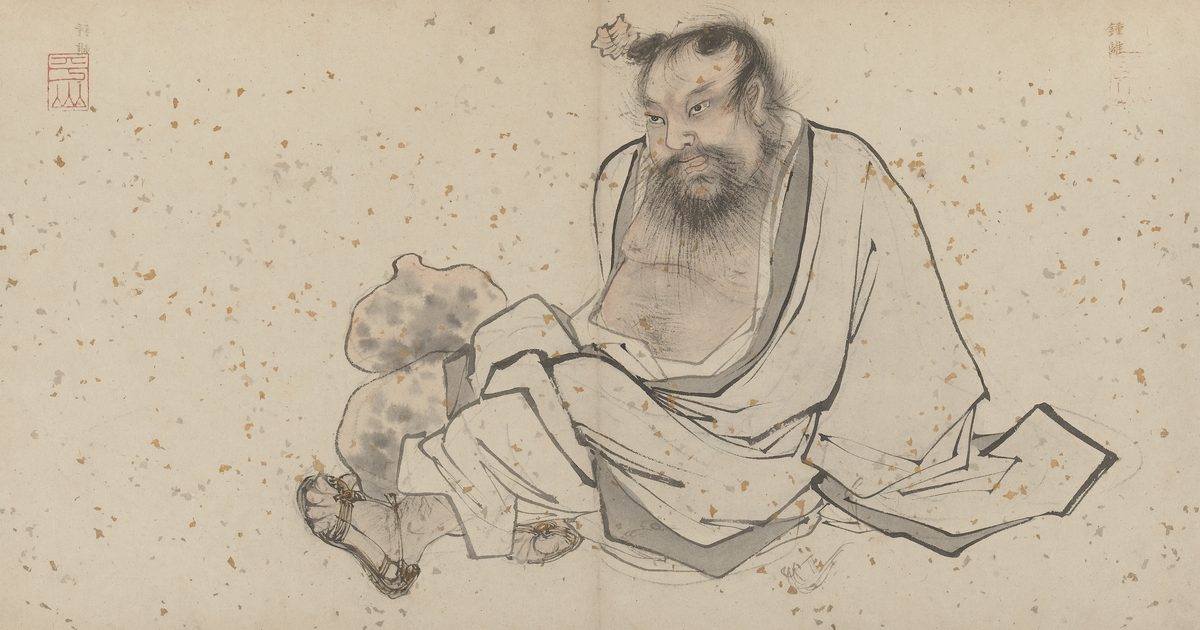
Zhongli Quan is classically shown bare-bellied with loose hair at the temples and a beard reaching his navel, holding a large palm-leaf fan, good-humored and often painted drinking. His fan can raise the dead and turn stones into gold and silver. In the Hidden Eight Immortals system the fan stands for him — "Lightly waving the fan in carefree joy." He is the patron deity of silversmiths.[2][1]
Folk Devotion
The Zhong–Lü transmission: the Quanzhen patriarch line
Zhongli Quan's special standing among the Eight Immortals comes from his master–disciple bond with Lü Dongbin — explicit in the earliest legends. Both the Southern lineage of the golden-elixir school and the northern Quanzhen school "traced their ancestry to the Way of Zhong and Lü," and Taoist books written after the two merged fixed the patriarch line: "First patriarch the Lord of the Eastern Florescence ... transmitting to second patriarch Zhongli Quan, who transmitted to third patriarch Lü Dongbin, whose teaching split into the northern and southern branches." He is honored as the Second Patriarch of the Quanzhen northern lineage.[6][7][3]
Quanzhen founder Wang Chongyang sang of himself: "Han Zhengyang (Zhongli) is my direct ancestor, Tang Chunyang (Lü) my master." Scholars note accordingly that the Eight Immortals appeared as a company only from the Yuan onward, inseparable from Quanzhen's rise — and that Zhongli and Lü are its core. Before accepting Lü Dongbin, Zhongli Quan set the famous "ten trials" (see the Lü Dongbin entry), then declared: "Worldly hearts are hard to extinguish, immortal talent hard to find; you withstood all ten trials — your attainment of the Way is certain." And he taught him the great Way.[5][7][3][4]
Sources and Transmission
The earliest records of Zhongli Quan
Zhongli Quan's legend first appears in the Northern Song. The Mengzhai Bitan records: "During the Five Dynasties, (Lü Dongbin) attained the Way from Zhongli Quan. Quan was a Han man, ageless." The Collected Biographies of Immortals adds: "Zhongli Quan, courtesy name Yunfang, of unknown origin, entered the Zhongnan Mountains at the end of the Tang." Scholars place him between the late Tang and early Song; the note "Quan was a Han man" was originally a remark on his surname and origin, later misconstrued as "a man of the Han dynasty" — hence the name Han Zhongli.[7][3]
The early Zhongli Quan "had little of the miraculous about him beyond living rather long." Only when the Yuan-dynasty Quanzhen school made him a founding patriarch did his figure fill out: Taoist name Zhengyangzi, a native of Xianyang (some say Yantai), once a general who left his family for the Zhongnan Mountains and received the art of immortality from the Lord of the Eastern Florescence. The Song titled him "Zhengyang Zhenren"; the Yuan added "Zhengyang Kaiwu Chuandao Zhenjun."[7][6]
Alternative Versions & Caveats
Zhongli Quan's era is genuinely disputed: the Mengzhai Bitan and the Collected Biographies of Immortals point to the late Tang–Five Dynasties, while "Han-dynasty general" and "Eastern Han man" are later accretions; his father Zhongli Zhang and the Tibetan campaign belong to the Taoist hagiographic tradition, not official history; in Journey to the East his defeat is engineered by Li Tieguai, differing from the "Liang Ji gave only old and weak troops" version.[7][3][8]
Sources
This page was compiled from the original pages below (each was fetched and checked against the text before writing); click a title to open the source. Ordering: encyclopedias first, authoritative sources after; self-media articles that could not be verified were excluded.
- [1]道家八宝(暗八仙) (in Chinese)↗
搜狗百科Encyclopedia
- [2]Zhongli Quan↗
英文维基百科Encyclopedia
- [3]钟离权 (in Chinese)↗
百度百科Encyclopedia
- [4]Lü Dongbin↗
英文维基百科Encyclopedia
- [5]八仙传说故事的文化底蕴探析(王永宽,《中州学刊》2007年第5期) (in Chinese)↗
明清史研究辑刊转载(网易)Authoritative source
- [6]八仙从何而来?(白化文《谈八仙》) (in Chinese)↗
网易号转载(学者专文)Authoritative source
- [7]你不知道的八仙“旧事”——从电视剧《蓬莱八仙》说起(李一鸣) (in Chinese)↗
澎湃新闻·澎湃号·湃客Authoritative source
- [8]《东游记》第十一回(钟离将兵伐寇) (in Chinese)↗
中国古典文学网Authoritative source
- [9]《东游记》第十八回(点金济众成仙) (in Chinese)↗
中国古典文学网Authoritative source
- [10]《汉钟离度脱蓝采和》(元杂剧全本) (in Chinese)↗
古诗文网Authoritative source
- [11]吕洞宾点石成金趣事(引《了凡四训》) (in Chinese)↗
书格(古籍影印资料站)Authoritative source
- [12]钟离权点石成金 (in Chinese)↗
百度百科Encyclopedia