THE EIGHT IMMORTALS · No. 1 OF 8
Li Tieguai
First of the Eight Immortals · Borrowing a Corpse to Return a Soul
His original name varies by source (Li Xuan, or Li Kongmu); respectfully called Master Iron-Crutch Li
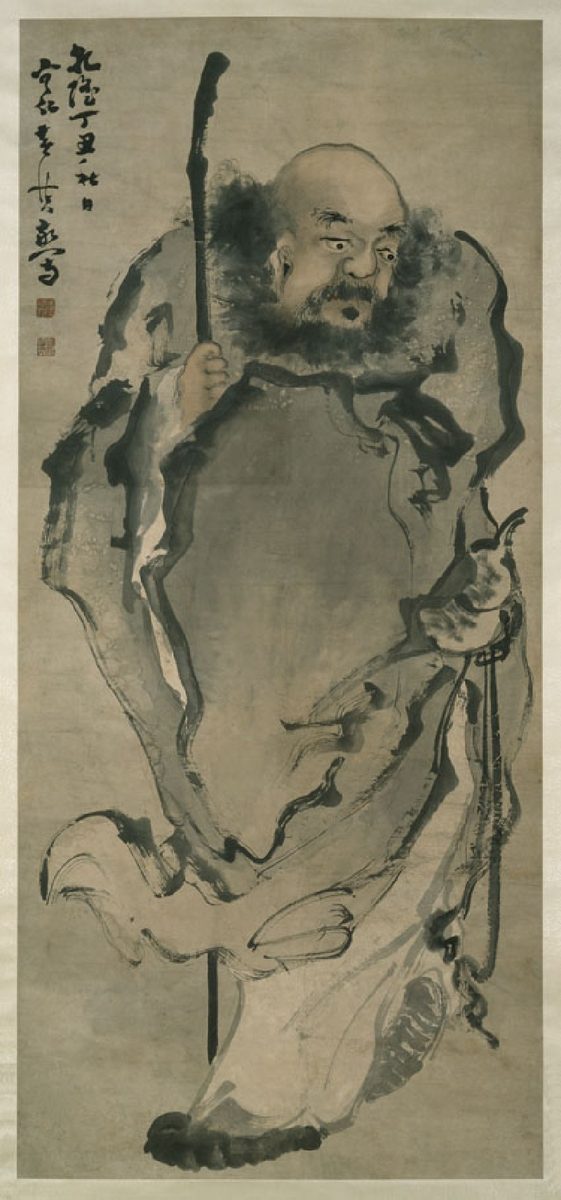
Li Tieguai · At a Glance
- Attribute
- Iron crutch, gourd
- Hidden Eight Immortals symbolism
- The gourd — "The gourd holds more than the five blessings" — it relieves all beings
- Patron of
- Medicine (an iron crutch still marks some traditional Chinese pharmacies)
- Folk counterpart
- The "poor" among male, female, old, young, rich, noble, poor, and lowly
Origins and Ascension
Borrowing a corpse: the most famous enlightenment story of the Eight Immortals
Qing-dynasty compendia such as the Comprehensive Mirror of Immortals Through the Ages and the Complete Biographies of the Assorted Immortals record: Li Tieguai was originally a commanding, accomplished recluse living in a cave on Mount Dang. Invited by Lord Lao to a gathering of immortals on Mount Hua, he told his disciple before leaving: "My roaming soul returns in seven days; if it does not, burn my body." On the sixth day the disciple, whose mother lay dying, cremated the body early. The returning spirit found no vessel and entered "through the fontanelle of a starved corpse" — borrowing a beggar's body, he rose to find himself "wild-haired and curly-bearded, big-eyed, bare-bellied and limping."[3]
Not even the elixir Lord Lao gave him could restore his former shape; the sage said: "I give you a golden band to bind your tangled hair and an iron crutch to prop your limping foot. When your work is complete, an unusual form is itself true immortality." He thereafter called himself Li Kongmu — "the origin of what the world calls Master Iron-Crutch." Another strand says Laozi twice tested his resolve with beauty and wealth, in vain; after his return he revived the disciple's mother with the elixir in his gourd, and ever since he has roamed as a healer, found wherever the poor and sick lie dying.[3][2]
Another version: enlightened by the Queen Mother of the West
The Ming Shantang Sikao preserves an earlier account: "The lame immortal's surname is Li, his name unknown; long lame of foot, he was enlightened to immortality by the Queen Mother of the West, made Lord of Eastern Florescence, and given an iron crutch." Here he is born lame, enlightened by the Queen Mother, and no corpse-borrowing occurs — the coexistence of versions itself showing the layered growth of the Eight Immortals legends.[3]
Iron-Crutch Li in Journey to the East
The opening chapters of Wu Yuantai's Ming-dynasty Journey to the East (Chronicle of the Eight Immortals of the Upper Cave) tell his enlightenment in full: Li Xuan, "of commanding bearing, gathering the purest qi of the five elements," neglected his family's affairs at twenty and "resolved to cultivate the truth," climbing Mount Hua to seek Lord Lao. As Lord Lao discoursed with Wan Qiu, "a sudden clear breeze" swept into the hall; reading the register of immortals, he declared "Li Tieguai is about to attain the Way," sent two lads to welcome him, and passed on the supreme teaching: "Strain not your form, spend not your essence ... and you may live long."[7]
The same book's chapter "Iron-Crutch Entrusts His Soul to a Starved Corpse" preserves another version of the corpse-borrowing: Li Xuan told his disciple Yang to guard his body for seven days; on the sixth, Yang's mother fell gravely ill, and before burning the body he wept a dirge: "My mother's illness will not lift, my master's soul has not returned ... to keep one I give up the other — the two cannot both be kept." When Li Xuan's spirit returned and found himself "without a single hair," he recalled Lord Lao's parting verse — "Would you regain your old shape, meet a new face" — and sighed, "The soul has nowhere to rest; what leisure to choose a body?" So he entered the body of a starved beggar — henceforth "wild-haired, dirty-faced, bare-bellied and lame of foot," and the crutch he spat water upon turned to iron. "Few in the world knew his name; all called him Master Iron-Crutch."[7]
Tales and Anecdotes
Hanging his gourd and testing Fei Changfang
Journey to the East also gives him an interlude of "serving his penance below": playing with a boy immortal, he startled the green ox — "seeing his crippled, ugly form, it took fright" — and it slipped its tether, descended to earth as an ox demon, and threw a great kingdom into chaos; Lord Lao caned the two lads and banished Iron-Crutch below to "redeem his fault." At Runan he appeared as an old man who "carried a gourd and sold medicine in the market, curing all who came"; at day's end he leapt into the gourd — the origin of the "hanging gourd" healer. He tried to convert the market-keeper Fei Changfang with three tests — "to sit alone among a pack of tigers," "to hang beneath a ten-thousand-jin stone by a rotten rope while rats gnawed it," and "to eat filth" — and Fei, unmoved through all, received the arts of immortality.[7]
He tried a night watchman too: the man said "how could a leaf boat carry such a load" and would not board; Iron-Crutch sighed, "your mortal thoughts weigh too heavily — you cannot be saved," leapt into the boat himself, and rode the wind into the clouds, where "Zhongli, Lancaihe, He Xiangu and other immortals pointed the way from upstream." Yet he did not forget the Yang household: Yang had burned his body only because his mother was dying — "he who kept not my body till the end was pressed to it by his mother ... if I do not raise her from the dead, he will bear regret all his life." He arrived with his gourd as Yang was "about to cut his own throat," took out a pill and fed it to the mother with water — "in a moment her breath returned and her face reddened; she sighed long and rose, as one who had never been ill." He gave Yang an elixir of longevity, and two hundred years later brought him to ascend with him.[7]
The hot-tempered senior
Chapter 37 of Journey to the East shows his temper at its best: as Iron-Crutch played chess with Zhongli Quan, Zhang Guolao brought word that Lü Dongbin, rejecting Zhongli's judgment, had descended to earth to help Empress Xiao's army form the seventy-two Heaven's Gate formations, leaving the Song dynasty in peril. Iron-Crutch "flew into a rage": "Heaven's order is not to be defied! The bounds of Hua and Yi are fixed — how dare he take sides! Dongbin has violated heaven's law ... I shall report him to the celestial court and damn this petty creature to no rebirth," and with that he "pushed the board aside and rose." But rage aside, he still sent He Xiangu to learn how Zhongli's mission fared — the temper comes fast, and so does the sense of right and wrong.[8]
Attributes and Iconography
Image and attributes
Li Tieguai is the most recognizable of the Eight Immortals: unkempt and dirty-faced, loose hair bound by a golden band, a tangled beard, an iron crutch and a gourd slung over his shoulder. He is the company's only disabled figure, and in the Journey to the East's narrative sequence he is ranked first among the Eight Immortals.[2][5][6]
In the Hidden Eight Immortals (the Taoist "eight treasures") system, the gourd stands for Li Tieguai — "The gourd holds more than the five blessings" — signifying relief for all beings. His crutch and medicine gourd are deeply bound to the medical trade: an iron crutch still hangs outside some traditional Chinese pharmacies, often compared by Western researchers to the rod of Asclepius.[1][2]
In the folk scheme matching the Eight Immortals to "male, female, old, young, rich, noble, poor, and lowly," Li Tieguai stands for the poor. Ill-tempered and eccentric, beggar- and clown-like in appearance, he is yet compassionate to the poor and sick — scholars see in his legend the model Eight Immortals spirit: "a mortal who bears injustice without complaint and gives more than he takes, attaining immortality at last."[4][2]
Folk Devotion
The drug immortal: patron of dog-skin plasters
Folklore also gives him the "dog-skin plaster": in Zhangde Prefecture (present-day Anyang, Henan) lived a plaster-maker, Boss Wang, known for his charity. On the way to a temple fair he met a lame beggar with a boil on his leg; three plasters he applied only made the sore spread until it was the size of a bowl. "The plasters of Zhangde — all fake!" the beggar cursed. Wang brought him home to compound a fresh remedy, when a big yellow dog lunged at the beggar and Wang killed it with one blow of his stick — "dog meat tonight!" the beggar laughed. When the new plaster was ready, the beggar was roasting the dog; he pressed the medicine to his leg, covered it with a piece of dog-skin, and in a moment peeled it off — the bowl-sized sore was gone, and the man had vanished. Boss Wang realized the lame immortal himself had come to pass on the formula. The tale made Li Tieguai the patron of dog-skin plasters — the medicine trade honored him as its drug immortal.[9]
Sources and Transmission
Name variations and layered legends
Sources wildly disagree on his era and name: the Ming Shantang Sikao says only "the lame immortal's surname is Li, his name unknown"; the common later version calls him Li Xuan; English Wikipedia has him born in the Yuan dynasty (1279–1368), while folklore makes him a disciple of Laozi — the 6th century BCE. These contradictions show a figure built up in layers of legend, best read with an implicit "legend has it."[3][2]
Alternative Versions & Caveats
Li Tieguai's name, era, and lineage vary enormously across sources — the Shantang Sikao declares his name unknown, and even the disciple's name (Yang in Journey to the East) and the reason for the cremation differ among versions of the corpse-borrowing. The "dog-skin plaster" story is folk legend preserved in the Baidu Baike entry for the plaster itself, not an old-text record. Specific "historical prototype" stories circulating online (e.g., the filial son lamed while brewing medicine for his mother) lack reliable old-text support and should be read as "legend has it."[3][2][7][9]
Sources
This page was compiled from the original pages below (each was fetched and checked against the text before writing); click a title to open the source. Ordering: encyclopedias first, authoritative sources after; self-media articles that could not be verified were excluded.
- [1]道家八宝(暗八仙) (in Chinese)↗
搜狗百科Encyclopedia
- [2]Li Tieguai↗
英文维基百科Encyclopedia
- [3]铁拐李 (in Chinese)↗
百度百科Encyclopedia
- [4]八仙传说故事的文化底蕴探析(王永宽,《中州学刊》2007年第5期) (in Chinese)↗
明清史研究辑刊转载(网易)Authoritative source
- [5]八仙从何而来?(白化文《谈八仙》) (in Chinese)↗
网易号转载(学者专文)Authoritative source
- [6]吴元泰《东游记》(《全相东游记上洞八仙传》版本著录) (in Chinese)↗
汉典古籍Authoritative source
- [7]《东游记》全文(明·吴元泰《上洞八仙传》,含铁拐李成道诸回) (in Chinese)↗
中国哲学书电子化计划Authoritative source
- [8]《东游记》第三十七回(铁拐李怒斥吕洞宾) (in Chinese)↗
东篱书斋Authoritative source
- [9]狗皮膏药(铁拐李传方传说) (in Chinese)↗
百度百科Encyclopedia