THE EIGHT IMMORTALS · No. 3 OF 8
Lan Caihe
Begging in Song · A Gender Mystery
Said to be born Xu Jian with the stage name Lan Caihe; also called the "Song-Stomping Immortal"
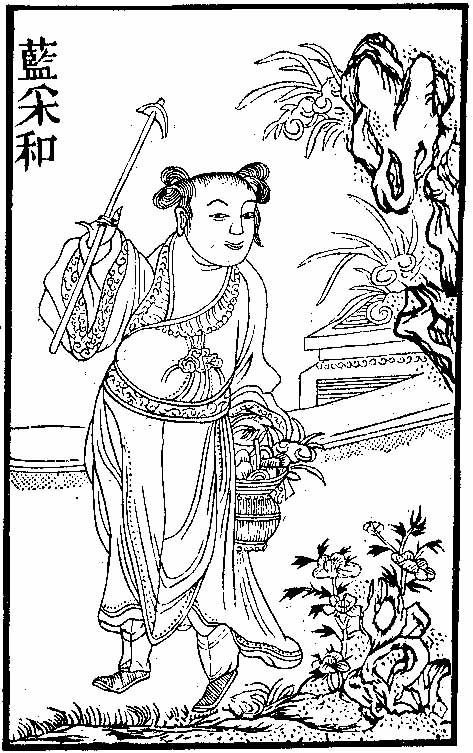
Lan Caihe · At a Glance
- Attribute
- Flower basket, three-foot clappers (versions vary; also a bamboo or herb basket)
- Hidden Eight Immortals symbolism
- The flower basket — "Nothing common is kept within the flower basket" — communing with the divine
- Patron of
- Florists, gardeners, and wandering minstrels
- Folk counterpart
- The "lowly" among male, female, old, young, rich, noble, poor, and lowly
Origins and Ascension
A street singer of unknown origin
Lan Caihe has the haziest origins of the Eight Immortals, first appearing in the Southern Tang Continued Biographies of Immortals by Shen Fen: "Lan Caihe, of unknown origin, always wore a tattered blue gown ... one boot shod, one foot bare. In summer he padded his gown with wadding; in winter he lay in the snow, his breath rising like steam. He went about the city singing for alms, carrying great clappers over three feet long."[3][4]
Three accounts of his ascension
Three ascension accounts circulate: rising on a cloud from an inn after casting down gown, belt, clappers and his one shoe; departing on a crane at the sound of pipes and flutes, casting down boots, gown, belt and clappers; or gaining immortality from Li Tieguai, disguised as a beggar whose running sores he had treated while gathering herbs.[3][2]
Tales and Anecdotes
The outlandish ways of a singing beggar
Legend makes him a wandering performer of the Tang (some say Five Dynasties) who stomped out songs for alms around Haozhou (present-day Fengyang, Anhui). The Extensive Records of the Taiping Era preserves his full eight-line song: "Stomp a song, Lan Caihe — how long can this world last? Rosy faces, trees of one spring; the flowing years, a thrown shuttle. The ancients go, never to return; those of today come more and more. At dawn I ride a phoenix to the azure sky, at dusk I watch the mulberry fields rise in white waves. The long light and clear brilliance hang in the void; gold and silver towers loom high." (The Complete Tang Poems version opens "Stomp, stomp the song"; the Continued Biographies of Immortals has "stomp-stomp song.") His lyrics mourned life's brevity and urged the Way, "beyond the grasp of vulgar minds." His tune was the tage — stomping time to the clappers, a song-and-dance form popular in Tang and Song.[7][3][2]
His dress and behavior are thick with symbolism: wadding-padded in summer, steaming in the winter snow; one boot on, one foot bare. The Extensive Records writes that the cash he begged he "strung on a long cord and dragged along the ground, never looking back when it scattered," giving to the poor or trading it to wine shops; to questions he answered "quick-witted and teasing, making all burst out laughing," "seemingly mad, not mad." A man who saw him as a child met him again with white hair — his face "exactly as before." Time itself seemed to stop around him.[7][2]
The Yuan poet Wu Qiuyan's Portrait of the Immortal Lan Caihe nails the "madness": "The copper cash draw fools' laughter in vain; the immortal machinery lies not necessarily in the stomped song" — the world laughed at his craziness while he had long seen through the ways of the world.[3]
In Journey to the East: the spark of a war
In the sea-crossing episode of Journey to the East, Lan Caihe is the trigger of the great war: returning from the Peach Banquet, the company, at Lü Dongbin's initiative, "each showed their divine power" to cross the sea, and Lan Caihe "threw his clappers into the water" and floated over on them. The dragon prince Moqie coveted the treasure, had him "seized, jade clappers and all, and drowned in the sea," and locked him in a dark chamber. When Lü Dongbin came to demand his return and was refused, he hurled his fire gourd and "burned the water's surface red, boiling the sea"; the Dragon King released Lan Caihe but kept the clappers. Weeping, Lan Caihe told the company of his "utter humiliation" and begged them to right the wrong.[6]
In chapter 49 Lü Dongbin beheaded Moqie and cut off the second prince's arm; in chapter 50 the Eight Immortals deployed in four columns ("Caihe and Xiangu held the right"), the fire gourds of Li Tieguai and Lü Dongbin joined by Zhongli's fan and He Xiangu's bamboo basket — "the Eastern Ocean burned until it was a plain of ashes," the Dragon King fleeing with his wife to the South Sea until heavenly soldiers and Guanyin brokered peace. The ever-smiling stomp-singer wept, appealed, and bore a grudge when wronged — that self-respect makes him the most human of the immortals.[6]
Attributes and Iconography
Image and attributes
Lan Caihe is the one member whose gender is ambiguous: writers and painters have made him male, female, a feminine-looking man, even androgynous. In Chinese opera he wears female dress but sings in a male voice; the Qing miscellany Gaiyu Congkao held him plainly male and called the female costume "utterly absurd."[2]
His attributes vary: the early records give the three-foot clappers and a bamboo basket (per the saying "Caihe shoulders his basket on one hand"), later tradition the flower basket, filled with plants of longevity — lingzhi, bamboo, pine, plum, chrysanthemum; in the Hidden Eight Immortals system it stands for him — "Nothing common is kept within the flower basket" — signifying communion with the divine. The flower basket is a common New Year motif and appears on a Qing imperial dragon robe.[3][1][2]
Folk Devotion
Patron of florists and wandering minstrels
The basket makes him patron of florists and gardeners; his singing career, patron of wandering minstrels. In the story of the Eight Immortals crossing the sea, Lan Caihe crosses on his jade clappers, is coveted and seized by the East Sea Dragon King, and hauled into the dragon palace — sparking the great war between the Immortals and the dragon clan (see the Eight Immortals story page).[2][5]
Sources and Transmission
Prototype and gender through the ages
He is generally thought to have no reliable historical prototype; one account makes him a Five Dynasties entertainer born Xu Jian with the stage name "Lan Caihe" — the version taken by the Yuan zaju Zhongli Quan Delivers Lan Caihe, where he sings variety plays, is flogged by the authorities at his fiftieth birthday, and is finally delivered to immortality by Zhongli Quan. Notably, Xu Jian was a real person whose poems appear in the Complete Tang Poems.[3][4][2]
A telling side note: since He Xiangu is always called the only woman among the Eight Immortals, Lan Caihe is tacitly not female — while the Illustrated Eight Immortals' Journey to the East flatly calls him "a man who did not know how to be one." His age is likewise unstable — an old man in early portraits, a boy of about sixteen in recent centuries. His face legendarily never aged for decades, making him an emblem of eternal youth and innocence.[2]
Alternative Versions & Caveats
Lan Caihe's name, era, gender, and attributes are all contested in the literature: gender is given as male, female, or androgynous; the attribute as clappers, bamboo basket, herb basket, or flower basket; some Qing scholars even held "Lan Caihe" to be merely a tune name. Note the version when citing.[2][3]
Sources
This page was compiled from the original pages below (each was fetched and checked against the text before writing); click a title to open the source. Ordering: encyclopedias first, authoritative sources after; self-media articles that could not be verified were excluded.
- [1]道家八宝(暗八仙) (in Chinese)↗
搜狗百科Encyclopedia
- [2]Lan Caihe↗
英文维基百科Encyclopedia
- [3]蓝采和 (in Chinese)↗
百度百科Encyclopedia
- [4]八仙从何而来?(白化文《谈八仙》) (in Chinese)↗
网易号转载(学者专文)Authoritative source
- [5]蓬莱的八仙传说 (in Chinese)↗
汉典古籍·民俗Authoritative source
- [6]《东游记》八仙东游过海(夺玉板、火烧东洋) (in Chinese)↗
中国哲学书电子化计划Authoritative source
- [7]《全唐诗》蓝采和《踏歌》 (in Chinese)↗
中国哲学书电子化计划Authoritative source