THE EIGHT IMMORTALS · No. 4 OF 8
Zhang Guolao
Riding His White Donkey Backward · Immortality by Corpse-Liberation
Born Zhang Guo, "Lao" being an honorific; also called the Taoist of Guangzong; Emperor Xuanzong of Tang granted him the title "Master Tongxuan"
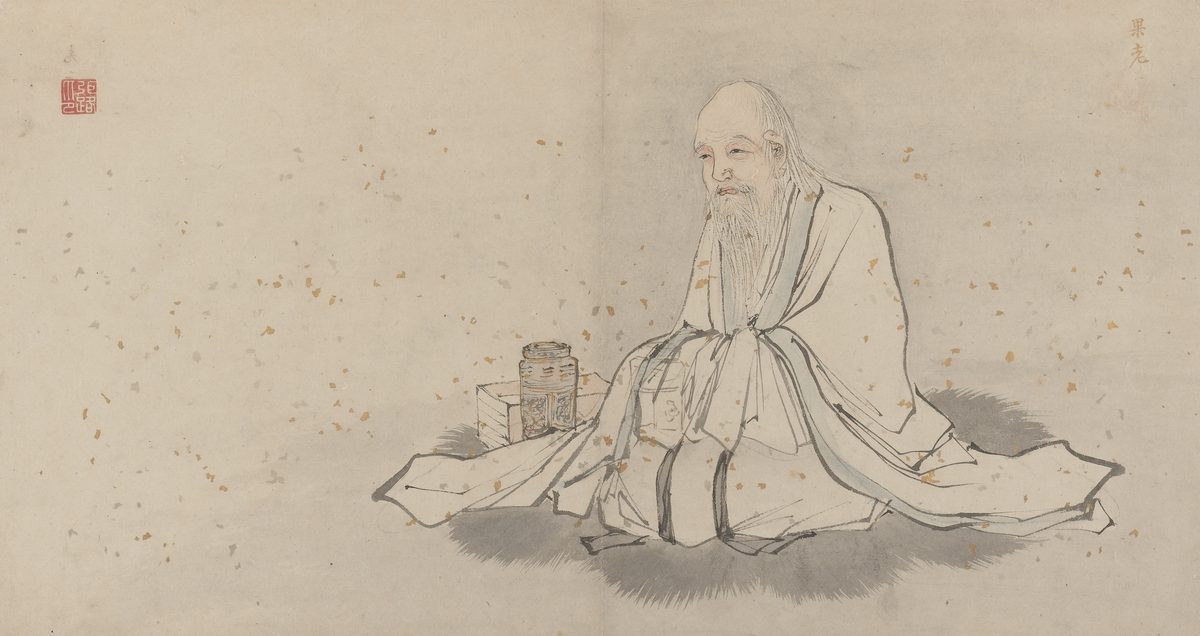
Zhang Guolao · At a Glance
- Attribute
- Fish drum (the daoqing tube, often with a phoenix feather or immortal peach)
- Hidden Eight Immortals symbolism
- The fish drum — "The fish drum's steady beats carry a sacred sound" — divining one's life
- Historical identity
- A Tang-dynasty fangshi (master of methods) with biographies in both Books of Tang, one of the few Immortals in official history
- Folk counterpart
- The "old" among male, female, old, young, rich, noble, poor, and lowly
Origins and Ascension
Zhang Guo in official history
Zhang Guolao is one of the few Eight Immortals to leave a trace in official history: both the Old and New Books of Tang carry his biography among the Adepts (Fangji), placing him roughly from the later 7th to the mid-8th century. He was a Tang fangshi living in seclusion in the Zhongtiao Mountains of Hengzhou (present-day Yongji, Shanxi), roaming between the Fen and Jin regions; the world said he had lived for centuries, and he claimed a previous life as a minister of the sage-king Yao.[5][2][3]
The fangshi who thrice defied the Son of Heaven
Emperors Taizong and Gaozong repeatedly summoned him; he declined. When Empress Wu Zetian summoned him again he finally set out — only to drop dead before the Temple of the Jealous Woman: the Tang Miscellaneous Records of the Ming Emperor records it as a feigned death, the corpse seen rotting and crawling with maggots, yet soon he was spotted hale in the Hengzhou mountains again.[2][3]
In 735 Emperor Xuanzong brought him to Luoyang, granted him an honorific office, and bestowed the title "Master Tongxuan." Curious who Zhang Guo really was, the emperor asked the Taoist Ye Fashan. The Extensive Records of the Taiping Era records Ye's answer: "I dare not say; to say it is to die." When the emperor promised to intercede, Ye spoke: "Zhang Guo is a white bat spirit from the first parting of chaos" — and fell dead. The emperor, barefoot, begged Zhang Guolao's forgiveness; Zhang sprayed water onto Ye's face and revived him. Later Zhang Guolao returned ill to the Zhongtiao Mountains and died; his disciples opened the coffin to find it empty — the classic "corpse-liberation" ending.[2][3]
Tales and Anecdotes
The old immortal who teased the Son of Heaven
The Extensive Records of the Taiping Era, volume 30 (drawn from the Tang Miscellany of the Ming Emperor and other books), details Zhang Guo's exchanges with Emperor Xuanzong. In 735 the emperor sent the gentleman attendant Pei Wu to fetch him by post-relay; Zhang Guo promptly "died on the spot," and only when Pei burned incense and conveyed the emperor's longing for the Way did he "gradually revive." In court the emperor found his teeth and hair decayed; Zhang answered, "In my decayed years, shameful indeed" — and plucked out his hair and knocked out his teeth on the spot, blood streaming, only to reappear in a moment with "dark locks and white teeth, better than in his prime."[7]
When the emperor proposed marrying him to Princess Yuzhen, he knew it beforehand, telling his visitors with a smile "to take a princess as wife is a fearsome thing," and burst out laughing when the matchmaker arrived (the Baidu Baike version has him singing instead: "To take a princess as wife — rise to a mansion in the tenth heaven. Men think it a joy; I think it a fear"). He claimed "a mountain minister drinks no more than two sheng," yet his disciple could hold a dou — a young priest of about sixteen dropped from the eaves, drank a dou without blinking, and when pressed, the wine spurted from the crown of his head and turned into a golden vessel in the Academy of Assembled Worthies; the emperor and his ladies "all gasped and laughed." The emperor's three probes failed in turn: the ghost-seer Shi Yeguang could not see Zhang Guo in his seat; the diviner Xing Hebu cast his counters and could not reckon his cycle; and Gao Lishi, by imperial order, served him aconite poison (jinjin) — he drank three cups, his teeth blackened, then had a page knock the black teeth out with an iron ruyi and put them in his belt, applied a red-glowing salve, and woke "firm and shining white, better than before."[7][3]
A deer best showed his age: the emperor had hunted a great stag, and Zhang Guo claimed to have freed it while attending the Shanglin Park in the fifth Yuanshou year of Emperor Wu of Han — check the left horn, he said, and there was the copper plaque, "two inches, more or less"; he also computed 852 years from Yuanshou to the present, "and the grand astrologer checked his long reckoning — no difference at all." He grew ever more unfathomable: he claimed to be "a man born in the bingzi year of Yao's reign," "a chamberlain in Yao's time," and the imperial rescript could only say he "knows not the count of his cycles and calls himself a man of Fuxi's age."[7]
Why ride backward?
Zhang Guolao's signature image is riding backward. Yuan Mei's Suiyuan Notes on Poetry quotes a jest on a Portrait of the Backward Rider: "Guolao rides his donkey backward, and none knows why — fearing that looking ahead, he might forget the road he came by"; an old inscription verse says "Of all the people in the world, none like this old man; it is not that he rides backward — he looks back at everything." The folk reading of the pose is "look back at the road you have traveled," matching the proverb "a thousand gold can't buy a look back."[8][3]
The folk origin tales are many and varied: the best-known "stolen ginseng" story makes him a little monk who stole the cooked ginseng root and fed the broth to the donkey, then, fearing the old abbot's pursuit, fled riding backward "watching behind him" — the donkey became a spirit donkey and he an immortal; the "Zhao Prefecture Bridge" version has him and Duke Chai (Chai Rong) test the bridge Lu Ban raised in a single night, the donkey loaded with sun, moon and stars and the cart with the Five Sacred Mountains, the bridge quaking until Lu Ban propped it from below — hoofprints and wheel-ruts remain in the stone, and the Hebei folk song "Little Cowherd" still sings "Zhang Guolao crossed the bridge on his donkey; Duke Chai's cart ground a groove."[3]
Attributes and Iconography
Riding backward: his most beloved image
Zhang Guolao traveled on a white donkey that covered a thousand li a day; his signature pose is riding backward, facing the tail, the daoqing tube on his back, roaming and singing daoqing songs. At journey's end he folded the donkey up: "at night he folded it like paper into a box; by day he sprayed it with water and it was a donkey again."[3][2][5]
In Wu Yuantai's Journey to the East, Zhang Guolao crosses the sea by throwing his paper donkey into the waves — backward riding and the foldable donkey run unbroken from Tang notebooks to Ming novels, his steadiest identity tags.[3][6]
Attribute and cultural symbol
His attribute is the fish drum — a bamboo-tube drum, the daoqing tube of his song preaching; in the Hidden Eight Immortals system it matches "The fish drum's steady beats carry a sacred sound," signifying the divining of one's life. He often also holds a phoenix feather or an immortal peach, emblems of longevity.[1][3][2]
Folk Devotion
Sources and Transmission
History and legend intertwined
A believer in spirit communion, he brewed herbal wine that other immortals found healing; a qigong master, he could go days without food on a few sips of wine. History and legend intertwine in him more than in any other Immortal.[2]
Alternative Versions & Caveats
English Wikipedia lists Zhang Guolao, Zhongli Quan, and Lü Yan as the three Eight Immortals who were "real people with a definite time and place in the historical record" — but the statement carries a disputed tag on the page. The rigorous phrasing is: Zhang Guolao appears in both Books of Tang (Biographies of Adepts) and is the most solidly documented of the Eight Immortals in official history. His backward riding is a legend motif; the folk origin stories (the stolen ginseng, the Zhao Prefecture Bridge) are rival versions, none of them history.[2][5][8]
Sources
This page was compiled from the original pages below (each was fetched and checked against the text before writing); click a title to open the source. Ordering: encyclopedias first, authoritative sources after; self-media articles that could not be verified were excluded.
- [1]道家八宝(暗八仙) (in Chinese)↗
搜狗百科Encyclopedia
- [2]Zhang Guolao↗
英文维基百科Encyclopedia
- [3]张果老 (in Chinese)↗
百度百科Encyclopedia
- [4]八仙传说故事的文化底蕴探析(王永宽,《中州学刊》2007年第5期) (in Chinese)↗
明清史研究辑刊转载(网易)Authoritative source
- [5]八仙从何而来?(白化文《谈八仙》) (in Chinese)↗
网易号转载(学者专文)Authoritative source
- [6]吴元泰《东游记》(《全相东游记上洞八仙传》版本著录) (in Chinese)↗
汉典古籍Authoritative source
- [7]《太平广记》卷三十·张果(出《明皇杂录》《宣室志》等) (in Chinese)↗
中国哲学书电子化计划Authoritative source
- [8]张果老为什么倒骑驴?(引袁枚《随园诗话》) (in Chinese)↗
运城新闻网(原载《鲁中晨报》)Authoritative source