THE EIGHT IMMORTALS · No. 5 OF 8
He Xiangu
The Only Female Immortal · Daylight Ascension
Born He Qiong (some say He Xiugu or He Erniang)
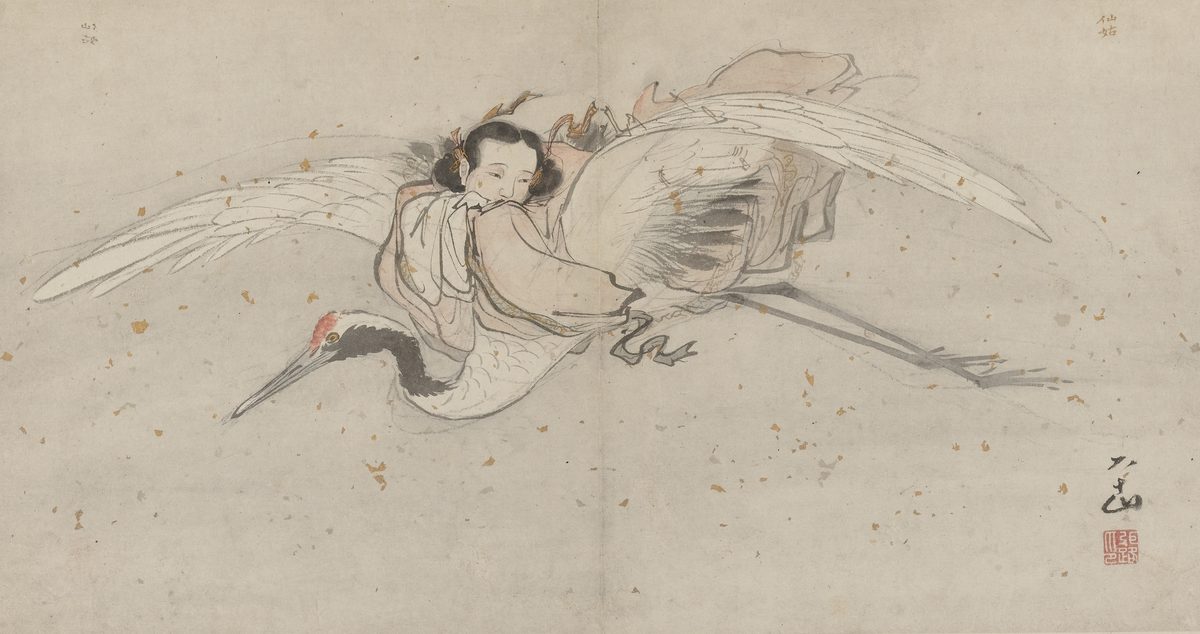
He Xiangu · At a Glance
- Attribute
- Lotus flower (sometimes a sheng reed-pipe or fly-whisk)
- Hidden Eight Immortals symbolism
- The lotus — "Holding the lotus, untouched by dust" — cultivating body and mind
- Birthplace
- Competing claims: Lingling, Yongzhou (Hunan) / Zengcheng, Guangzhou (Guangdong), among others
- Folk counterpart
- The "female" among male, female, old, young, rich, noble, poor, and lowly
Origins and Ascension
The ascension story in Traces of Immortals and Buddhas
Per Hong Yingming's Ming-dynasty Traces of Immortals and Buddhas: He Xiangu, daughter of He Tai of Zengcheng, was born with six long hairs on her crown. At about fourteen a divine being told her in a dream: "Eat powdered mica, and your body will grow light and you will never die." She complied, vowed never to marry, and gradually gave up ordinary food.[2][3]
Empress Wu Zetian sent an envoy to summon her to court, but she vanished on the road to the capital. One day in the Jinglong era (707–710) of Emperor Zhongzong, she ascended to immortality in broad daylight.[2]
In Journey to the East: the mica-eating maiden
Chapter 22 of Journey to the East, "The Immortal Maiden Attains Immortality in a Dream," has her at fourteen or fifteen dreaming a divine being told her: "Eat powdered mica, and your body will grow light and you will never die." She reasoned "the words of a divine being cannot deceive me," took the powder, "and knew her body was light," and thereafter "came and went in the valleys, flying on foot, returning at dusk each day with mountain fruit" — fruit she brought home to her mother. She "vowed firmly never to marry, and her mother could not force her"; later she met Li Tieguai and Lan Caihe by a stream, received their teaching, and in the Jinglong era was led by Li Tieguai to ascend in broad daylight.[9]
Tales and Anecdotes
Di Qing's inquiry: the account in Duxing Zazhi
The Northern Song miscellany Duxing Zazhi records a famous tale of her powers: marching south against Nong Zhigao's rebellion, General Di Qing passed Yongzhou and asked He Xiangu to divine the campaign's outcome. She answered: "You need not even see the rebels; they will be defeated and flee." Di Qing doubted her at first — yet after a few clashes Nong Zhigao indeed fled to the Dali kingdom.[2][3]
The clever druggist's daughter outwits Lü Dongbin
In a tale told around Hangzhou she is a sharp-tongued girl: Lü Dongbin, disguised as a Taoist, came to the shop asking for four medicines — "the harmony powder of home, the ease decoction of obedience, the disinfection pill of concord, and the elixir of long life without vexation." He Xiangu answered promptly: "Kind fathers and filial sons are the harmony powder of home; brothers who respect each other are the ease decoction; harmony among sisters-in-law is the disinfection pill; few desires and no worries, the elixir of long life." The shop applauded; the Taoist praised her — "You certainly know how to sell medicine!" — and rose into the air. Only then did she recognize him as the old man who had given her a peach when she was lost in the mountains at thirteen. The tale preserves her quick wit in folklore.[10]
Attributes and Iconography
Attribute and cultural symbol
He Xiangu carries a lotus, said to improve people's health of body and mind; she is sometimes shown with a sheng reed-pipe or a phoenix, or with a bamboo ladle or fly-whisk. In the Hidden Eight Immortals system the lotus stands for her — "Holding the lotus, untouched by dust" — signifying cultivation of body and mind.[2][1]
Folk Devotion
The ancestral temple at Zengcheng and its relics
At Xiaolou town in Zengcheng, Guangdong, stands the He Xiangu Ancestral Temple, rebuilt in the eighth year of Xianfeng (1858); the plaque "Temple of He Xiangu" is the work of the Qing calligrapher Huang Peifang, and the couplet reads: "A thousand years of shoes and footsteps left at the cinnabar well; a hundred generations of caps and robes bow before the old shrine." The ancient well inside, originally called the "Heavenly Flower Well," bears on its octagonal granite rim the words "The immortal spring trickles on; those who drink live ten thousand years" — the very spot where she is said to have left her shoes: the wells for li around taste brackish, and only this one is sweet.[7]
On the temple ridge grows a century-old peach tree that fruits every year without water or fertilizer — the immortal peach of the Queen Mother's feast, the story goes; some 400 meters north, a "coiling dragon vine" covering about a mu and over four centuries old is said to be her sash turned to wood. Locals tell of the temple's "five wonders": in 1940 a Japanese bomb fell into the temple without exploding; fires around have repeatedly "gone out by themselves at the temple wall"; and in drought years a herbalist climbing the cliff of the "Seventh Fairy Cave" met the immortal, who led him into a grotto of rare flowers and taught him to make a cooling jelly that saved the fever victims — the plant, liangfencao, has been called "immortal herb" ever since.[8][7]
The Zengcheng County Gazetteer's Mount Luofu story shows her "yearning for home yet not for the world": her house faced Mount Luofu across the plain; on the eve of her wedding she vanished, and at dawn only a pair of shoes lay by the well. Later a Taoist came down from Luofu with word that the immortal sat on a rock at Magu Terrace, and asked her parents to take up the shoes by the well. Flying over a lychee tree, her sash caught on a branch and the silk threads clung to the fruit — thus Zengcheng's famous "gualü" lychee; the polished stone mirror she used is still on the mountain.[7]
Sources and Transmission
The only woman among the Eight Immortals
He Xiangu, born He Qiong, is the only woman in the canonized company of the Eight Immortals (Lan Caihe's gender is debated). Said to be of the Tang dynasty, her birthplace is contested between Lingling in Yongzhou, Hunan, and Zengcheng in Guangzhou, Guangdong, among others; in some versions she is a shopkeeper's daughter.[2][3]
She joined the company late: Ma Zhiyuan's Yuan play Lü Dongbin Thrice Drunk at Yueyang Tower still has Xu Shenweng in her place; the earliest surviving script to seat her among the Eight Immortals is Fan Kang's Chen Jiqing Boards the Bamboo-Leaf Boat by Mistake. Her final admission reflects the Ming vogue for female immortals — the "seven men and one woman" lineup.[5][4]
Contested hometowns and rival versions
The Lingling version: He Qiong of Yongzhou met an old man at fourteen who fed her a celestial peach and taught her to eat mica; thereafter she could foresee human affairs, and in the first Jinglong year she ascended in daylight with Li Tieguai, a pearl shoe falling to earth and becoming a well. The Zengcheng version makes her Xiugu, daughter of tofu-maker He Tai, fed the immortal peach and mica by Li Tieguai, Lü Dongbin and others; Zengcheng's famous "gualü" lychee is hung on her legend too — she is said to have hung her green silk sash on the lychee tree, or to have spat a pit that grew into the green-skinned fruit.[3]
A third version concerns "He Erniang," a Guangzhou shoe-weaver who gathered bayberries for the monks of Mount Luofu and was taken for a fairy descended to earth; when Emperor Xuanzong sent an envoy for her, she vanished en route to the capital — "some scholars guess this He Erniang is the He Xiangu of Zengcheng." Hengshan, Yingshang, Wuping and Hezhou each have their own He Xiangu legends as well.[3]
Scholar Pu Jiangqing observed that her "prototype was pieced together from several shamanesses" — the root reason her hometown is fought over and her versions contradict one another: legend accreting in layers.[5][6]
Alternative Versions & Caveats
He Xiangu's birthplace is claimed by Lingling, Zengcheng, Hengshan, Yingshang, Wuping, Hezhou and more; her given name varies (He Qiong, He Xiugu, He Erniang), and accounts of her ascension diverge widely; the "immortal maiden" seen by Northern Song writers such as Ouyang Xiu was even described as a frail old woman with a dark, wrinkled face, far from the later fairy image. Distinguish the documentary versions when citing.[3][5]
Sources
This page was compiled from the original pages below (each was fetched and checked against the text before writing); click a title to open the source. Ordering: encyclopedias first, authoritative sources after; self-media articles that could not be verified were excluded.
- [1]道家八宝(暗八仙) (in Chinese)↗
搜狗百科Encyclopedia
- [2]He Xiangu↗
英文维基百科Encyclopedia
- [3]何仙姑 (in Chinese)↗
百度百科Encyclopedia
- [4]八仙传说故事的文化底蕴探析(王永宽,《中州学刊》2007年第5期) (in Chinese)↗
明清史研究辑刊转载(网易)Authoritative source
- [5]八仙从何而来?(白化文《谈八仙》) (in Chinese)↗
网易号转载(学者专文)Authoritative source
- [6]永怀恩师浦江清先生(浦江清1936年发表《八仙考》) (in Chinese)↗
清华大学Authoritative source
- [7]何仙姑老家就在广州增城(据《增城县志》《广州非物质文化遗产志》) (in Chinese)↗
广州市情网·广州市人民政府地方志办公室Authoritative source
- [8]何仙姑与增城荔枝的传说 (in Chinese)↗
中国新闻网Authoritative source
- [9]《东游记》第二十二回(仙姑得梦成仙) (in Chinese)↗
古诗文网Authoritative source
- [10]何仙姑的传说与仙迹(孙长庚) (in Chinese)↗
道网(腾讯道学转载)Encyclopedia