THE EIGHT IMMORTALS · No. 6 OF 8
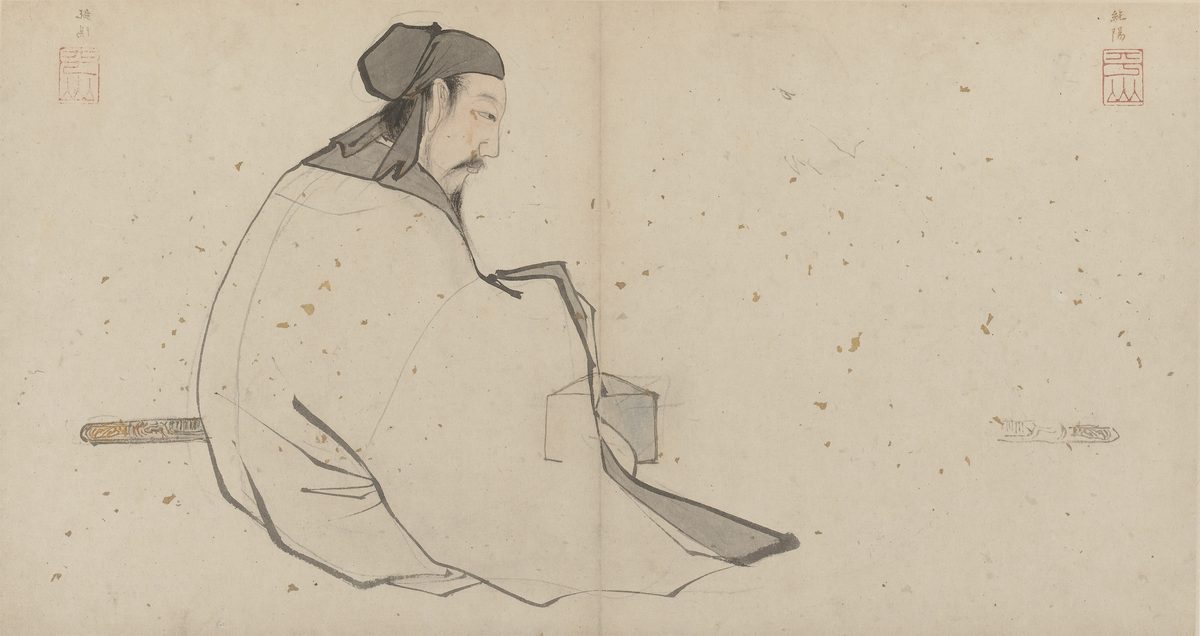
Lü Dongbin
Patriarch Chunyang · The Golden Millet Dream
Born Lü Yan, courtesy name Dongbin, Taoist name Chunyangzi; revered as Patriarch Lü and Fuyou Dijun
Lü Dongbin · At a Glance
- Attribute
- Sword (the Chunyang Sword)
- Hidden Eight Immortals symbolism
- The sword — "The sword flashes with numinous light, striking fear into demons" — it wards off evil
- Birthday
- 14th day of the 4th lunar month
- Historical identity
- A Tang-dynasty Taoist and poet recorded in the History of Song, with poems in the Complete Tang Poems
- Folk counterpart
- The "male" among male, female, old, young, rich, noble, poor, and lowly
Origins and Ascension
Early life
He was reportedly born around 796 at Yongle, Puzhou (present-day Ruicheng, Shanxi); the 14th day of the 4th lunar month is his birthday. A Yuezhou stone inscription preserves his supposed autobiography: "I am a man of the capital; failing the late-Tang examinations repeatedly, I wandered Mount Hua, where Zhongli taught me the formula of the golden elixir ..." — in the earliest telling, a failed Confucian scholar. The Song titled him "Miaotong Zhenren," the Yuan "Chunyang Yanzheng Jinghua Fuyou Dijun," and the Quanzhen school counts him among its Five Northern Patriarchs — he is commonly called Patriarch Lü.[4][3][6][5]
The Golden Millet Dream
His most famous story is the Golden Millet Dream: at an inn in Chang'an (some say Handan), he fell asleep while the millet cooked, and dreamed he passed the examinations, married well, and rose to chancellor — then fell from grace, lost everything, and woke at the point of death to find Zhongli Quan smiling and the millet still not done. Eighteen dream years in one cooking time; he awoke to the truth that "life is but a dream" and followed Zhongli Quan into the mountains.[3]
The tale was not originally his: an earlier version in the Song Extensive Records of the Taiping Era (drawn from the Tang tale "The World Inside a Pillow") stars a Scholar Lu and an Old Man Lü. Only in the Yuan did Ma Zhiyuan and others graft it onto Lü Dongbin as his awakening story, in the zaju The Golden Millet Dream.[3][6]
Zhongli Quan's ten trials
Before accepting him as a disciple, Zhongli Quan is said to have set ten trials: unmoved by a dying relative; uncomplaining when cheated of payment; laughing off a beggar's insults; shielding sheep from a starving tiger with his own body; resisting a seductress; refusing found gold; returning copper vessels that turned to gold; unharmed by a pill that meant "death or immortality"; calm in a storm mid-river; and, when ghosts came to claim his life, saying "I owed you a life in a past existence — take it," at which they vanished. Zhongli Quan appeared laughing, took him into the mountains, and taught him the golden-liquid elixir — the lineage later known as the Zhong–Lü golden elixir tradition.[3][2]
Tales and Anecdotes
Traces at Yueyang and the Pavilion of Three Drunkennesses
His stories "first spread around Chang'an, but they are told most and remembered deepest at Yueyang." Passing through under the Northern Song, he rested beneath an old pine whose tree spirit saw through his disguise, and wrote on the wall: "Alone I walk, alone I sit; countless people know me not. Only the old tree spirit south of the city clearly saw an immortal pass." The prefect Li Guan found the poem, and the pavilion later built beside the pine became the Lüxian Pavilion, founded in the Northern Song.[7][6]
His line "Three times drunk at Yueyang, unrecognized, I chant and fly over Dongting Lake" gave the city its Pavilion of Three Drunkennesses by the Yueyang Tower. Per Yueyang local records, it was also Lü Dongbin who started the Eight Immortals crossing the sea "each showing their divine power" — he proposed that "none may cross on clouds; each must throw an object into the sea and cross upon it," and the other immortals agreed.[7]
Yueyang folklore makes the game-playing even richer: at Prefect Fang's sixtieth-birthday banquet, Lü Dongbin sat on the ground among the fishermen, drinking and toasting everyone he met, and capped the crooked verse of the rich man Jia with his own — "By dawn I rove the north, at dusk reach Cangwu; the green snake in my sleeve makes me bold of breath. Three times drunk at Yueyang, unrecognized, I chant and fly over Dongting Lake" — then walked across the waves toward Junshan and was gone. He also visited Teng Zijing, who rebuilt Yueyang Tower, four times, leaving a fan inscribed "To share the Way with others is the Way; to share virtue with others is virtue," and when he read the words "worry before all the world, rejoice after all the world," he circled "worry" and "rejoice" with wine, and they burst into golden light.[10]
The flying sword against Huanglong
"Lü Dongbin Flies His Sword to Behead Huanglong," chapter 22 of the Ming vernacular collection Stories to Awaken the World, is the best-known tale of Lü's contests: Lü boasted to his master that he would deliver three thousand people in the Central Plains within three years. Zhongli Quan laughed out loud: "Among the world's beings the disloyal are many and the unfilial legion ... I send you for three years — if you find one, it will be your merit." He gave him the great demons-subduing sword Tai'a, "capable of flying to take a head," with three injunctions: do not pick fights with monks, do not lose the sword, and return within the three-year limit — on pain of "death and annihilation of form."[8]
Down the mountain, Lü failed to deliver Yin of Luoyang and Grand Commandant Wang of Kaifeng; with his three years nearly spent, he came to the foot of Mount Huanglong in Huangzhou, where Master Fu "fed monks, not Taoists" and praised the Chan master Huinan of Huanglong Temple. Lü, "his chest swelling with rage," went up the mountain sword in hand to contest verses with the master: "An iron ox plows and plants money-seeds; a stone child threads the line. In one grain of millet hides a world; in half a sheng cauldron cook rivers and mountains." Huinan answered "one grain can transform three thousand worlds; the great sea must yet receive a hundred streams," seized him, and asked: "If a grain cannot transform three thousand worlds, how does your grain hide a world? And half a sheng of cauldron cooks rivers and mountains — where is the other half sheng?" Lü had no answer; a blow of the master's ruler raised a lump on his head, and he left with "three laughs, three shakes of the head, three claps of the hands."[8]
The more he brooded, the angrier he grew; at the third watch he sent his sword flying as a blue dragon to behead Huinan — but the master froze it fast in the earth, and Lü himself was shut in the Rock of Entangled Demons to meditate. Returning to the Zhongnan Mountains to confess, he was given a letter from Zhongli Quan to his dharma-brother the Pīle Buddha; Huinan, seeing the letter, enlightened him with "the elixir is at the sword's point; the sword is in the elixir's heart," and Lü, suddenly seeing, wrote the verse "Today I understand Huanglong's art; only now I know my past effort was in vain" and "settled his nature, cultivated the truth, and did not come down the mountain for centuries." The tale ends with a grace note: on the wall of the Tianqing Abbey in Fengxiang someone found, in the hand of the "Daoist Hui," the verse "Eight hundred autumns since I attained the Way; never once did I fly a sword to take a head."[8]
The three seductions of White Peony
Chapters 27 and 28 of Journey to the East tell a famous romantic episode in Luoyang: seeing the singing girl White Peony, "a beauty to topple cities," Lü reflected "of gentlewomen one may not speak lightly, but of a girl of the flowers one may try his luck" — and came to her door as a handsome scholar with his sword as a page and a lump of white gold, calling himself "the Daoist Hui." The two "spent the night till dawn in mutual contest," yet Lü lost no essence; Peony, "weak-boned and spiritless," sighed "you are no common man."[9]
Li Tieguai and He Xiangu, disguised as a beggar couple, taught her to "touch his ribs with her finger at the height of passion"; Lü startled and lost his essence, and confessed "I am Chunyang," giving her a gift "with which you may leave the mortal realm" — and White Peony too attained immortality. The Peking opera Three Seductions of White Peony (also called Chunyang Sports with the Grotto) relocates the tale to Mount Lao, where he meets a girl of the same name who has not yet completed her cultivation, and they become lovers at first sight. The affair has always been the best footnote to Lü's "righteous and unrighteous" image, and the origin of the folk debate over whether the Patriarch was a womanizer.[9]
The deliverer in the marketplace
Around Junshan they tell how he helped the fishermen: a fishing-boss tyrant squeezed the fishermen, so Lü Dongbin, disguised as a beggar, sold "the prescription for long life without death," and bade the tyrant fill a little porcelain jar with his silver — dozens of sacks of treasury silver would not fill it; Lü laughed, poured the silver out, and gave it all to the fishermen, who knelt at the crossroads calling him a "living immortal." He also tested men with his gold-turning art: a prefect wanted only wealth; a woodcutter preferred a beauty to an immortal destiny — both failed, and he "wept aloud three times" and left dead drunk. To weep at a failed deliverance is exactly the true feeling behind his "gravity of heart."[10]
The eightieth transformation, "Delivering Zhang Zhennu," in the Miraculous Transformations of the Divine Patriarch Chunyang shows him saving a courtesan: Zhang Zhennu of Wuxing, though fallen into the wind-and-dust trade, bathed and burned incense every evening, praying to heaven to escape her suffering. Lü visited her for months in the guise of a scholar, "never crossing the line," saying only "what matters between people is that the heart knows the heart," and taught her the sitting formula "in the hours before and after noon, sit in settled breath." Before leaving he wrote her a lyric whose last line was "say only that the gentleman's name was Lü." She fasted, practiced, and a year later freed her body. He delivered without regard to rank, treating even the lowly with sincerity — one reason the incense before his temples has never died out.[11]
Attributes and Iconography
An immortal with human flaws
Lü Dongbin is no perfect saint: fond of drink, hot-tempered in his early immortal years, and carrying a folk reputation for womanizing that keeps the unlucky-in-love from praying to him. The proverb "a dog bites Lü Dongbin — failing to know a good heart" hangs on his name. He described his own regimen as three swords: "one to cut off deluded vexation, one to cut off deluded anger, one to cut off deluded desire."[3][4][7]
The sword and the scholar image
Folk Devotion
The thriving cult of Patriarch Lü
That very earthiness is why the cult of Patriarch Lü flourished: it began to thrive in the late Northern Song, with dedicated temples by the Southern Song; in 1269 the Yuan titled him "Chunyang Yanzheng Jinghua Zhenjun" and in 1310 added "Fuyou Dijun." The early-Qing scholar Liu Xianting marveled: "Of the Buddhist bodhisattvas, Guanyin; of the immortals, Chunyang ... they take all the incense." The "Patriarch Lü divination lots," a hundred lots used for marriage, career, and fortune, remain popular across South China and the overseas Chinese communities of Southeast Asia.[12]
Sources and Transmission
The de facto core of the Eight Immortals
Lü Dongbin is the best-known and most storied of the Eight Immortals. Scholar Bai Huawen famously judged that "it was Lü Dongbin who truly gathered the Eight Immortals together," and a Yueyang municipal feature calls him first in rank among them. He was a Tang Taoist scholar and poet whose work entered the Complete Tang Poems; the History of Song records that "the recluse Lü Dongbin of Guanxi was skilled in swordsmanship and kept a boyish face past a hundred" — one of the few Immortals with an official-history footing, widely regarded as one of the earliest masters of inner alchemy.[5][7][3]
Alternative Versions & Caveats
Lü Dongbin's birthplace is most often given as Yongle, Ruicheng (Shanxi), and his given name varies between Lü Yan, Lü Shaoxian and others; internet "historical prototype" claims (e.g., a Tang imperial clansman who changed his surname in hiding) lack reliable documentary support. His enlightenment episodes (the millet dream, the ten trials, the flying sword against Huanglong, the three seductions of White Peony) were largely elaborated in Yuan-dynasty drama and fiction and should be distinguished from early records such as the History of Song.[4][3][6]
Sources
This page was compiled from the original pages below (each was fetched and checked against the text before writing); click a title to open the source. Ordering: encyclopedias first, authoritative sources after; self-media articles that could not be verified were excluded.
- [1]道家八宝(暗八仙) (in Chinese)↗
搜狗百科Encyclopedia
- [2]钟离权 (in Chinese)↗
百度百科Encyclopedia
- [3]Lü Dongbin↗
英文维基百科Encyclopedia
- [4]吕洞宾 (in Chinese)↗
百度百科Encyclopedia
- [5]八仙从何而来?(白化文《谈八仙》) (in Chinese)↗
网易号转载(学者专文)Authoritative source
- [6]你不知道的八仙“旧事”——从电视剧《蓬莱八仙》说起(李一鸣) (in Chinese)↗
澎湃新闻·澎湃号·湃客Authoritative source
- [7]吕仙“三亭”今犹在,缘在“朗吟过洞庭”(吕洞宾与岳阳专题) (in Chinese)↗
岳阳市人民政府官网Authoritative source
- [8]《醒世恒言》第二十二卷(吕洞宾飞剑斩黄龙) (in Chinese)↗
中国哲学书电子化计划Authoritative source
- [9]《东游记》第二十七回(洞宾戏白牡丹) (in Chinese)↗
汉典古籍Authoritative source
- [10]吕洞宾朗吟过洞庭(岳阳民间传说) (in Chinese)↗
岳阳市君山区人民政府门户网站Authoritative source
- [11]《纯阳帝君神化妙通纪》卷五(度张珍奴第八十化) (in Chinese)↗
识典古籍Authoritative source
- [12]从民祀到正祀:清代崇封吕祖史事补考 (in Chinese)↗
中国道教协会网Authoritative source