THE EIGHT IMMORTALS · No. 7 OF 8
Han Xiangzi
Converting His Uncle at Lan Pass · The Flute That Summons Snow
Courtesy name Qingfu (some say Beizhu); identified with Han Xiang, grandnephew of Han Yu
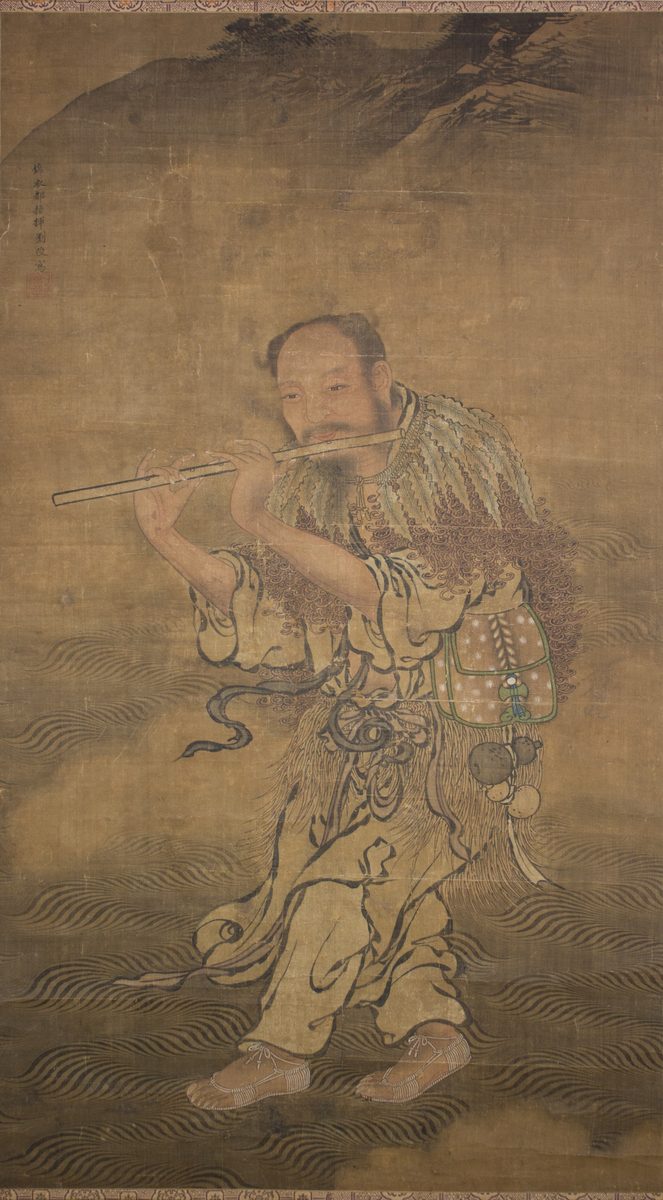
Han Xiangzi · At a Glance
- Attribute
- Transverse flute (the purple-golden xiao)
- Hidden Eight Immortals symbolism
- The flute — "The purple flute calms a thousand waves" — making all things flourish
- Patron of
- Flute-playing musicians
- Folk counterpart
- The "young" among male, female, old, young, rich, noble, poor, and lowly
Origins and Ascension
The historical prototype: Han Yu's grandnephew
Han Xiangzi's historical prototype is generally taken to be Han Xiang, grandnephew of the great Tang writer Han Yu. Baidu Baike's entry notes: "Per the New Book of Tang and Han Yu's Epitaph for Han Pang, Xiang — courtesy name Beizhu — was Han Yu's grandnephew, rose to Assistant Minister of the Court of Judicial Review, and was no man of the immortals." This Han Xiang passed the jinshi examination in 823: a real Tang official.[3][2]
In 819 Han Yu's memorial against welcoming the Buddha's bone relic earned him exile to Chaozhou; passing Lan Pass (present-day Lantian, Shaanxi) he wrote "Shown to My Grandnephew Xiang at Lan Pass upon My Demotion" — source of the famous line "Clouds bar the Qinling peaks, where is my home? Snow crowds Lan Pass, my horse will not go on." This real exile became the legend's most famous stage.[2][3]
Tales and Anecdotes
Converting his uncle at Lan Pass: from prophecy to fulfillment
The Tang-dynasty Biography of the Immortal Han already has the full outline: raised to immortality by Lü Dongbin, Han Xiang sought to convert his uncle Han Yu — pouring a whole banquet's wine from an inch-wide gourd, blooming a lotus from a brazier whose petals bore the couplet "Clouds bar the Qinling peaks, where is my home? Snow crowds Lan Pass, my horse will not go on." When Han Yu was later exiled and snowbound at Lan Pass, Han Xiang appeared; "Your words have come true!" Han Yu awoke. Han Xiang escorted him to his post and finally raised him to immortality too.[3]
The books also embroider his apprenticeship: Journey to the East says he "went out seeking a master, met Chunyang and Yunfang, abandoned his family to follow them, and received their Way"; The Complete Story of Han Xiangzi (chapter 4) has him meeting Zhongli Quan and Lü Dongbin at Sajin Bridge, and when the two masters asked "would you learn long life, or learn office?" he answered "long life" — they taught him the golden-elixir formula by night. When Han Yu learned of it he beat him and drove the masters away, yet Han Xiangzi kept cultivating even locked in his study, finally scaling the wall to Mount Zhongnan — where Zhongli Quan tested his resolve anew by claiming "you came late; I have already delivered another."[7]
The 17th-century novel The Complete Story of Han Xiangzi fleshes it out: the orphaned Han Xiangzi, raised by Han Yu and married to Minister Lin's daughter, sets his heart on the Way instead of office; he leaves home, becomes an immortal under Lü Dongbin and Zhongli Quan, and returns again and again to enlighten his uncle. The Journey to the East gives a similar but far briefer version.[2]
The little immortal at the birthday feast
Chapter 17 of the Ming novel The Complete Story of Han Xiangzi stages a great show at Han Yu's birthday feast: Han Xiangzi took an empty wine jug from the servant Zhang Qian and, chanting a spell, poured out 356 cups from the one jug; all the officials applauded — only Han Yu refused to drink. He then chanted over the stone steps and opened a golden lotus whose petals bore the words: "Clouds bar the Qinling peaks, where is my home? Snow crowds Lan Pass, my horse will not go on."[5]
Han Yu called it "conjuring tricks to swindle money" and demanded a confession. Xiangzi answered in jest: "My house is inside the South Heaven Gate" and "right beside the Dragon-tower Hall of the Supreme Void" — and only when the torture rack was brought did he "confess," weeping: "My uncle is Han Yu, courtesy name Tuizhi; my aunt is Dou." Then he painted a mountain on the wall, called the painted qilin down from it, and swept out real mountains and rivers with a broom, inviting the officials up — Han Yu, afraid of falling, would not climb, so Xiangzi gave him a push, and the company found itself standing on the hall roof; when Aunt Dou called her daughter-in-law Luying to "grab him," she could not catch him. Beneath the game-playing, he was putting the Lan Pass prophecy before his uncle's eyes again and again.[5]
The unlettered genius
Before he was an "immortal," Han Xiangzi was first a genius who gave his elders headaches. The Qingzuo Gaoyi says he "was free and unrestrained, did not study, loved drink, and sang loudly when drunk"; when Han Yu scolded him for ignorance he answered: "What I have learned is not what you know." In the Youyang Zazu he entered the academy and "bullied all the young scholars." Yet Journey to the East judges him "neither beautiful women nor fine wine could sway his heart or drown his will" — the worldliness was all surface; the mind for the Way was firm within.[8]
Attributes and Iconography
Attribute and legends
Han Xiangzi carries a transverse flute (the purple-golden xiao); legend makes him the composer of the Taoist music "Tianhua Yin" and patron deity of flute players. In the Hidden Eight Immortals system the flute stands for him — "The purple flute calms a thousand waves" — signifying the power to make all things flourish.[2][1]
Folklore also gives him a dragon-princess romance: his xiao was cut from a sacred bamboo of the South Sea purple grove, a gift of the East Sea Dragon King's seventh daughter — his playing drew the dragon girl from the sea, their love forbidden by the Dragon King, and an old fisherwoman passed him the sacred bamboo that became his magic flute. The tale is adapted in many later operas and TV dramas.[3][2]
Sources and Transmission
Prototype and the growth of the legend
The Tang miscellany Youyang Zazu records the other thread: a grandnephew of Han Yu who disliked study changed the color of peonies before his uncle's astonished eyes — the germ of the "Xiangzi conjures flowers" motif. Scholar Bai Huawen points to the episode "Xiangzi foretells the Duke's fate in verse" in the Song collection Qingzuo Gaoyi as the true headwater of the Han Xiangzi story.[2][4]
At the novel's end Han Yu is finally converted: the jade decree restores him to his old post as Curtain-Rolling General, with Aunt Dou and Luying each returning to their celestial offices — "one son's ascension raises nine generations to heaven," and Xiangzi's own parents were delivered as well. The Yuan zaju Han Xiangzi Thrice Delivers Han Tuizhi, the Ming Han Xiangzi Nine Times Delivers the Lord of Wenzhang, and the novel's "twelve deliverances" inflate the count ever higher — folklore even has "nine times for the Duke, ten for his wife" — converting his uncle became his great obsession.[6][8]
Alternative Versions & Caveats
The historical Han Xiang was a jinshi of 823 who rose to Assistant Minister of the Court of Judicial Review — "no man of the immortals." His miraculous deeds come chiefly from fiction and drama from the Youyang Zazu and Qingzuo Gaoyi onward (the "twelve deliverances and the whole family's ascension" of the Complete Story of Han Xiangzi are plainly novelistic); scholars link his apotheosis to mythmaking around Han Yu's anti-Buddhism. He should not be treated as historical fact.[3][2][4][8]
Sources
This page was compiled from the original pages below (each was fetched and checked against the text before writing); click a title to open the source. Ordering: encyclopedias first, authoritative sources after; self-media articles that could not be verified were excluded.
- [1]道家八宝(暗八仙) (in Chinese)↗
搜狗百科Encyclopedia
- [2]Han Xiangzi↗
英文维基百科Encyclopedia
- [3]韩湘子 (in Chinese)↗
百度百科Encyclopedia
- [4]八仙从何而来?(白化文《谈八仙》) (in Chinese)↗
网易号转载(学者专文)Authoritative source
- [5]《韩湘子全传》第十七回(韩愈寿宴) (in Chinese)↗
中国哲学书电子化计划Authoritative source
- [6]《韩湘子全传》第三十回(一家飞升) (in Chinese)↗
国学梦Authoritative source
- [7]《韩湘子全传》第四回(洒金桥遇师) (in Chinese)↗
古诗文网Authoritative source
- [8]韩湘子传说 (in Chinese)↗
百度百科Encyclopedia